
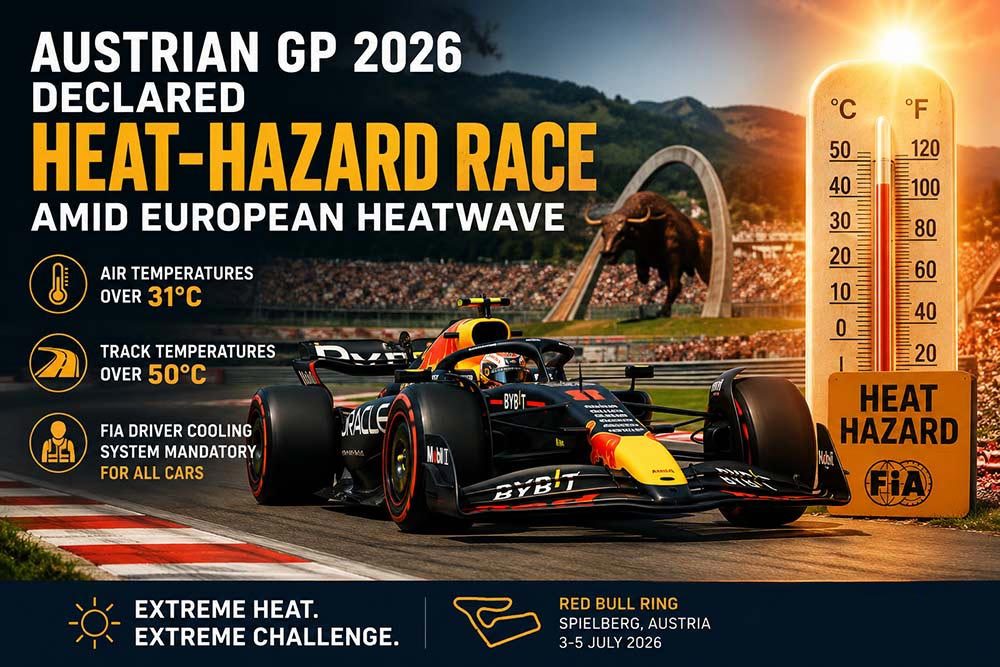
Austrian GP 2026 Declared Heat-Hazard Race Amid European Heatwave
The 2026 Austrian Grand Prix is set to be one of the hottest Formula 1 races in recent memory after the FIA officially declared the event a Heat Hazard due to an intense European heatwave. With air temperatures forecast to exceed 31°C and track temperatures expected to climb beyond 50°C, drivers and teams face one of the biggest physical challenges of the season.
Held at the picturesque Red Bull Ring in Spielberg, Austria, the Grand Prix is renowned for its fast, flowing layout and dramatic elevation changes. However, this year’s race weekend will test not only the performance of the cars but also the endurance of the drivers as extreme heat becomes a significant factor.
What Does a Heat Hazard Declaration Mean?
The FIA introduced the Heat Hazard protocol following concerns raised after drivers suffered severe heat exhaustion during previous hot-weather Formula 1 events. The regulations allow race officials to activate additional safety measures whenever the predicted heat index exceeds a specified threshold.
For the Austrian Grand Prix, the declaration means teams must install the FIA-approved Driver Cooling System in every car. This system can circulate cooled liquid through a specially designed vest worn underneath the driver’s race suit, helping to regulate core body temperature during the race.
Although the cooling equipment must be fitted to the car, drivers still have the option of whether to wear the cooling vest itself. Those choosing not to use it must instead carry additional ballast to ensure there is no competitive advantage.
Extreme Conditions at the Red Bull Ring
Weather forecasts indicate that race-day temperatures could reach the low-to-mid 30s Celsius, while the asphalt is expected to exceed 50°C under clear skies. Combined with the physical demands of driving a modern Formula 1 car, cockpit temperatures are likely to rise well above the outside air temperature.
Drivers already contend with:
- Multi-layer fireproof race suits
- Full-face helmets
- Limited cockpit ventilation
- High G-forces under braking and cornering
- Significant dehydration during a race distance
These conditions mean competitors can lose several kilograms of body weight through perspiration over the course of a Grand Prix.
Strategy Could Be Influenced by the Heat
The soaring temperatures are expected to affect more than just driver comfort.
Teams will closely monitor tyre degradation, brake temperatures and engine cooling throughout the weekend. Higher track temperatures generally accelerate tyre wear, potentially leading to revised pit-stop strategies and greater emphasis on tyre management.
Driver fitness could also become a deciding factor. Maintaining concentration over the full race distance is essential at the Red Bull Ring, where even a minor mistake can prove costly.
Safety Takes Centre Stage
The FIA’s decision reflects Formula 1’s increasing focus on driver welfare as climate conditions become more extreme. While Formula 1 has always raced in demanding environments, recent years have highlighted the importance of ensuring drivers can compete safely without compromising performance.
The Heat Hazard protocol was first introduced in 2025 and has now been activated for the first time during the 2026 season, underlining how exceptional the forecast conditions are for Austria this weekend.
Looking Ahead
Despite the challenging weather, fans can still expect an exciting Austrian Grand Prix. The Red Bull Ring’s combination of long straights, heavy braking zones and sweeping corners has produced memorable races in recent seasons, and the added challenge of extreme heat could create further unpredictability.
For spectators attending the event, staying hydrated, seeking shade and planning for prolonged exposure to the sun will be just as important as following the on-track action.
As Formula 1 continues to evolve, the Austrian Grand Prix serves as another reminder that success is not only about speed and engineering, but also about adapting to the ever-changing conditions that make motorsport one of the world’s most demanding sports.