
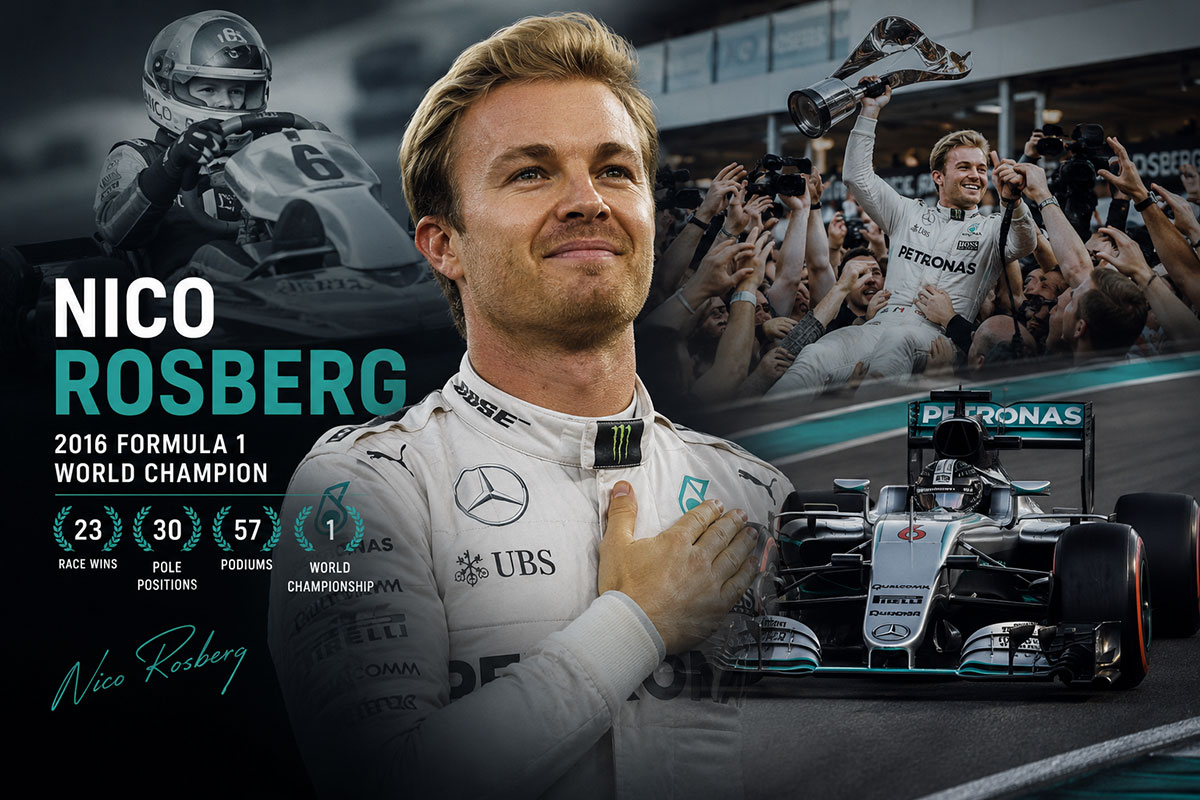
Nico Rosberg: The Formula 1 Career of a World Champion
Nico Rosberg’s Formula 1 career is one of determination, resilience and ultimate success. Although he spent much of his career competing against some of the greatest drivers in modern Formula 1, Rosberg proved that relentless dedication and mental strength could overcome even the toughest challenges. His rivalry with Lewis Hamilton became one of the defining stories of Formula 1’s hybrid era, culminating in a dramatic 2016 World Championship before his surprise retirement just days after achieving his lifelong dream.
With 23 Grand Prix victories, 30 pole positions, 57 podium finishes and the 2016 Formula 1 World Championship, Rosberg leaves behind a legacy as one of the finest drivers of his generation.
Early Life
Nico Erik Rosberg was born on 27 June 1985 in Wiesbaden, Germany. Motorsport was part of his life from birth. His father, Keke Rosberg, won the 1982 Formula 1 World Championship, while his mother, Sina, is German. Raised in Monaco, Nico grew up surrounded by Formula 1 and quickly developed a passion for racing.
Despite his motorsport background, Rosberg excelled academically. He became fluent in several languages and was offered a place to study aeronautical engineering before choosing to pursue racing full-time. His analytical approach would later become one of his greatest strengths in Formula 1.
Karting Success
Rosberg began karting at a young age and rapidly established himself as one of Europe’s brightest young talents. During his karting career he frequently competed against another future Formula 1 World Champion, Lewis Hamilton.
The pair became teammates during the 2000 Formula A karting season, unknowingly beginning a rivalry that would eventually define Formula 1 over a decade later. While Hamilton often had the upper hand in karting, Rosberg demonstrated exceptional consistency and technical understanding that impressed many within the paddock.
Rising Through the Junior Categories
Rosberg’s move into single-seater racing proved highly successful.
His achievements included:
- Formula BMW ADAC Champion (2002)
- Strong performances in Formula 3 Euro Series
- GP2 Series Champion (2005)
Winning the inaugural GP2 Championship in 2005 immediately established Rosberg as one of Formula 1’s hottest prospects and earned him a race seat with Williams for the following season.
Formula 1 Debut with Williams
Rosberg made his Formula 1 debut for Williams at the 2006 Bahrain Grand Prix.
It was an impressive introduction to the sport. He finished seventh and set the fastest lap of the race, immediately demonstrating both speed and maturity.
Although Williams were no longer championship contenders, Rosberg consistently outperformed expectations. Between 2006 and 2009 he established himself as one of the grid’s most promising young drivers, regularly scoring points despite limited machinery.
His standout moments included:
- Fastest lap on debut
- Multiple top-five finishes
- Second place at the inaugural Singapore Grand Prix in 2008
- Consistent qualifying performances
Many believed it was only a matter of time before Rosberg joined a front-running team.
Joining Mercedes
In 2010 Rosberg signed for Mercedes GP as the manufacturer returned to Formula 1 following its acquisition of Brawn GP.
His teammate was none other than seven-time World Champion Michael Schumacher, who had returned from retirement.
Many expected Schumacher to dominate, yet Rosberg frequently outqualified and outscored the Formula 1 legend during their three seasons together.
This period significantly enhanced Rosberg’s reputation within Formula 1, proving he possessed genuine world championship potential.
First Grand Prix Victory
Rosberg’s breakthrough finally arrived at the 2012 Chinese Grand Prix.
Starting from pole position, he delivered a faultless performance to claim his maiden Formula 1 victory.
The win ended years of speculation about whether he could convert his obvious speed into race-winning performances and marked the beginning of Mercedes’ rapid rise towards Formula 1 dominance.
The Hamilton Rivalry Begins
The arrival of Lewis Hamilton at Mercedes in 2013 created one of Formula 1’s greatest modern rivalries.
Having raced each other since childhood, the former friends became fierce championship rivals.
Initially their relationship remained respectful, but as Mercedes developed the fastest car on the grid, the battle intensified.
Between 2014 and 2016 both drivers fought for race victories and World Championships in identical machinery, producing some unforgettable moments.
Their rivalry featured:
- Wheel-to-wheel battles
- Qualifying duels
- Team tension
- Psychological warfare
- Controversial on-track incidents
It became one of the defining stories of the hybrid Formula 1 era.
Championship Challenges
Rosberg came agonisingly close to the title in both 2014 and 2015.
In 2014 he won five Grands Prix and remained in championship contention until the final race at Abu Dhabi before Hamilton secured the title.
In 2015 Hamilton again prevailed, although Rosberg finished the season strongly by winning the final three races.
Rather than becoming discouraged, Rosberg used those victories as motivation heading into 2016.
He refined every aspect of his preparation, working extensively on fitness, mental resilience and race craft.
That attention to detail would ultimately prove decisive.
The Perfect Championship Season
Rosberg began 2016 in sensational form, winning the opening four races.
Although Hamilton fought back strongly during the second half of the season, Rosberg maintained remarkable consistency throughout the year.
The championship remained undecided until the final race in Abu Dhabi.
Hamilton deliberately slowed the pace during the closing laps in an attempt to bring rival cars into contention and increase the pressure on Rosberg.
Despite enormous pressure, Rosberg remained calm and crossed the finish line in second place—enough to secure his first Formula 1 World Championship by five points.
It represented the fulfilment of a dream that had begun more than two decades earlier.
Retirement at the Top
Just five days after becoming World Champion, Rosberg shocked the sporting world by announcing his immediate retirement from Formula 1.
His decision surprised fans, teams and even Mercedes management.
Rosberg explained that achieving his childhood ambition had required complete dedication and enormous personal sacrifice.
Having finally become World Champion, he chose to leave the sport at its peak rather than defend his title.
Very few Formula 1 drivers have retired immediately after winning the Drivers’ Championship, making Rosberg’s decision one of the most remarkable exits in motorsport history.
Career Statistics
Rosberg’s Formula 1 record remains highly impressive:
- Formula 1 World Championships: 1 (2016)
- Formula 1 Starts: 206
- Race Wins: 23
- Pole Positions: 30
- Podiums: 57
- Fastest Laps: 20
- Teams: Williams, Mercedes
- GP2 Champion: 2005
Life After Formula 1
Since retiring, Rosberg has remained active within motorsport and business.
He regularly appears as a Formula 1 television analyst and commentator, offering detailed technical insights gained during his racing career.
Away from broadcasting he has become a successful entrepreneur and investor, supporting sustainable technologies, electric mobility and innovative start-up companies.
Rosberg also remains involved in Formula E and various environmental initiatives, reflecting his interest in the future of sustainable motorsport.
Nico Rosberg’s Legacy
Although Rosberg competed during one of Formula 1’s most competitive eras, he achieved something very few drivers have managed—defeating Lewis Hamilton over a full championship season in equal machinery.
His story is not simply one of natural talent, but of relentless preparation, intelligence and resilience.
Rosberg demonstrated that success at the highest level often comes through meticulous attention to detail, mental strength and an unwavering commitment to continuous improvement.
His dramatic championship victory in 2016, followed by one of Formula 1’s most unexpected retirements, ensures that Nico Rosberg will always be remembered as one of the sport’s most fascinating and respected World Champions.
Frequently Asked Questions
How many Formula 1 World Championships did Nico Rosberg win?
Nico Rosberg won one Formula 1 Drivers’ World Championship in 2016.
Which teams did Nico Rosberg race for?
He raced for Williams from 2006 to 2009 and Mercedes from 2010 until his retirement in 2016.
How many Formula 1 races did Nico Rosberg win?
Rosberg won 23 Formula 1 Grands Prix during his career.
Why did Nico Rosberg retire?
He retired just five days after winning the 2016 Formula 1 World Championship, stating he had achieved his lifelong ambition and wished to prioritise family life.
Did Nico Rosberg beat Lewis Hamilton?
Yes. Rosberg defeated Hamilton to win the 2016 Drivers’ Championship by five points despite Hamilton winning more races during the season.
Experience Formula 1 with Grand Prix Adventures
Grand Prix Adventures offers expertly organised Formula 1 travel packages to some of the world’s most exciting races.
Packages can include carefully selected hotels, race tickets, transfers and dedicated support, allowing guests to concentrate on enjoying the atmosphere and action of a Grand Prix weekend.
Explore the latest Formula 1 packages and start planning an unforgettable motorsport experience.