
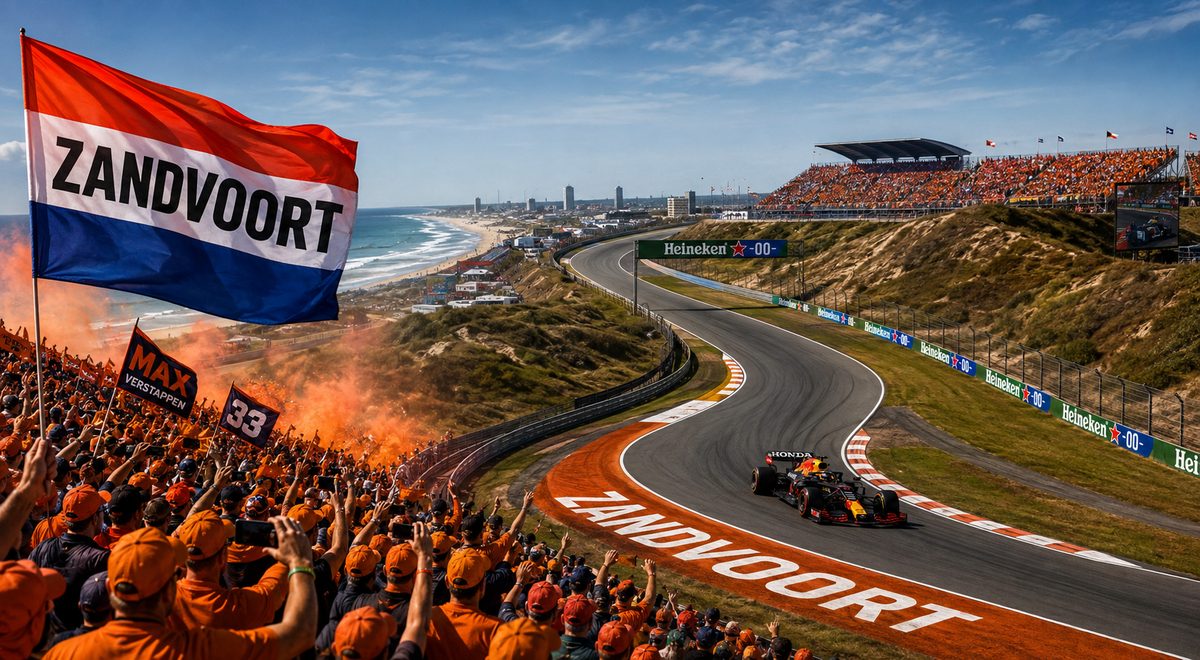
Formula 1 Dutch Grand Prix
The Dutch Grand Prix has one of the most distinctive histories in Formula 1. Staged among the sand dunes of the North Sea coast at Zandvoort, the race has welcomed some of the greatest drivers in motorsport, disappeared from the Formula 1 calendar for more than three decades and then returned to become one of the most colourful events of the modern championship.
Circuit Zandvoort is unlike many of the purpose-built Formula 1 venues seen today. Its narrow layout, elevation changes, fast corners and famous banking create an old-school challenge where drivers have little room for error.
From Alberto Ascari and Jim Clark to Niki Lauda and Max Verstappen, the Dutch Grand Prix has produced an impressive list of winners. Its story stretches back to the years immediately following the Second World War and continues to play an important part in Formula 1 history.
The Origins of Racing at Zandvoort
Motor racing in Zandvoort actually predates Formula 1.
The seaside town hosted a race on a temporary street circuit on 3 June 1939. The event proved successful and helped create interest in establishing a permanent racing circuit in the area.
Plans were interrupted by the Second World War, but the idea was revived after the conflict. The permanent Circuit Zandvoort was eventually completed in 1948, winding its way through the natural sand dunes close to the North Sea.
The first race at the new circuit was held on 7 August 1948 and was won by Prince Bira of Siam.
The original circuit was approximately 4.2 kilometres long and already contained several of the corners that would become synonymous with Zandvoort. The combination of elevation changes, sweeping bends and the sandy coastal environment quickly gave the circuit a character of its own.
Formula 1 was still in its infancy at the time. The official Formula One World Championship had only begun in 1950, but it wasn’t long before the Netherlands became part of the growing international championship.
The First Formula 1 Dutch Grand Prix – 1952
The Dutch Grand Prix became an official round of the Formula One World Championship for the first time in 1952.
Ferrari dominated the inaugural championship Dutch Grand Prix.
Italian star Alberto Ascari won the race, finishing ahead of Ferrari teammates Giuseppe Farina and Luigi Villoresi to give the Scuderia a remarkable 1-2-3 finish.
Ascari was the dominant force in Formula 1 during this period and went on to secure the 1952 World Championship. He returned to Zandvoort the following year and won again.
The early Dutch Grands Prix established Zandvoort as a genuine test of driver skill, and the circuit soon became associated with some of the biggest names of Formula 1’s formative years.
Formula 1 Legends at Zandvoort
As Formula 1 developed through the 1950s and 1960s, Zandvoort became a regular fixture on the calendar.
Juan Manuel Fangio, Stirling Moss, Jack Brabham, Graham Hill and Jackie Stewart were among the legendary drivers to achieve success in the Netherlands.
However, one driver became particularly associated with dominating the circuit: Jim Clark.
The brilliant Scotsman won the Dutch Grand Prix four times during the 1960s, taking victories in 1963, 1964, 1965 and 1967.
Clark’s smooth and precise driving style was perfectly suited to Zandvoort’s flowing layout. His four victories remain part of the circuit’s rich history and underline why he is still regarded as one of the greatest Formula 1 drivers of all time.
The Dutch Grand Prix also witnessed the evolution of Formula 1 machinery during an extraordinary period of technological development.
Front-engined cars gave way to revolutionary rear-engined designs, while aerodynamics became increasingly important. Zandvoort provided a spectacular backdrop as Formula 1 entered an increasingly sophisticated and professional era.
The Challenge of the Zandvoort Circuit
Part of the Dutch Grand Prix’s appeal has always been the circuit itself.
Rather than being built on completely flat land, Zandvoort follows the natural contours of the coastal dunes. The result is a circuit featuring rises, dips, blind approaches and flowing corners.
Perhaps the best-known section is Tarzan Corner, the tight right-hander at the end of the main straight.
The unusual name has become part of Zandvoort folklore, although several different stories exist about exactly how the corner received it.
Tarzan has traditionally provided one of the circuit’s best overtaking opportunities because drivers approach it at high speed before braking heavily for the turn.
Other famous sections of the historic circuit included Scheivlak and the Hunserug. Combined with the constant presence of sand being blown across the venue, they helped give Zandvoort a character quite unlike most other Grand Prix circuits.
The circuit was fast, unforgiving and dangerous, particularly by modern standards.
The 1970s – Triumph and Tragedy
The 1970s represented one of Formula 1’s most dramatic periods, and Zandvoort experienced both the excitement and dangers of the era.
Jochen Rindt, Jackie Stewart, James Hunt, Mario Andretti and Alan Jones were among the drivers who won Dutch Grands Prix during the decade.
The circuit was also the scene of tragedy.
Piers Courage lost his life during the 1970 Dutch Grand Prix after crashing his De Tomaso. Three years later, British driver Roger Williamson was killed following an accident during the 1973 race.
Williamson’s accident became particularly remembered because fellow driver David Purley stopped his own car and desperately attempted to rescue him from the burning wreck.
Such incidents highlighted the serious safety problems facing Formula 1 at the time.
Zandvoort subsequently underwent changes as motorsport increasingly recognised the need for improved barriers, run-off areas, circuit design and emergency procedures.
Hunt, Lauda and the Great F1 Rivalries
The Dutch Grand Prix was also a stage for some of Formula 1’s greatest drivers and rivalries.
James Hunt claimed his first Formula 1 victory at Zandvoort in 1975, driving for the relatively small Hesketh Racing team.
It was a remarkable result.
Hunt defeated Niki Lauda’s Ferrari in a performance that demonstrated his ability to compete with the established stars of the championship. A year later, Hunt and Lauda would become protagonists in one of Formula 1’s most famous World Championship battles.
Other major winners during Zandvoort’s original era included Mario Andretti, Nelson Piquet, Alain Prost and René Arnoux.
By the early 1980s, however, the future of the Dutch Grand Prix was becoming increasingly uncertain.
Niki Lauda Wins the Final Dutch GP of the Original Era
The original chapter of Formula 1 racing at Zandvoort came to an end in 1985.
McLaren teammates Niki Lauda and Alain Prost fought for victory, with Lauda ultimately defeating the Frenchman by less than a second.
It proved particularly significant because it was the final Grand Prix victory of Lauda’s extraordinary Formula 1 career.
It was also the last Dutch Grand Prix for more than three decades.
Financial difficulties surrounding the circuit and redevelopment of the surrounding area contributed to Formula 1 disappearing from Zandvoort.
Few supporters attending the 1985 race could have imagined just how long the wait would be before Formula 1 cars returned to the Dutch dunes.
Life at Zandvoort Without Formula 1
Although Formula 1 disappeared, Zandvoort did not cease to be an important motorsport venue.
The circuit was shortened and modified, while national and international racing continued.
One particularly important event was the Masters of Formula 3.
The prestigious meeting attracted many of the world’s most promising young drivers. Future Formula 1 stars including David Coulthard, Lewis Hamilton and Valtteri Bottas achieved success at Zandvoort during their junior careers.
The circuit therefore continued to have a connection with Formula 1 even when it was absent from the Grand Prix calendar.
DTM and numerous other categories also raced at Zandvoort, helping maintain the circuit’s international reputation.
Then a Dutch driver emerged who would completely transform Formula 1’s popularity in the Netherlands.
The Max Verstappen Effect
Max Verstappen’s arrival in Formula 1 created enormous new interest in the sport throughout the Netherlands.
He made his Formula 1 debut in 2015 and quickly developed a huge following. His aggressive racing style, spectacular overtaking and subsequent success with Red Bull Racing turned him into one of the country’s biggest sporting stars.
Thousands of Dutch supporters began travelling across Europe to Formula 1 races.
Grandstands at events including Belgium, Austria and Hungary became seas of orange as Verstappen’s travelling support grew.
Inevitably, attention turned towards bringing the Dutch Grand Prix back.
On 14 May 2019, Formula 1 officially announced that Zandvoort would return to the World Championship.
The first race was scheduled for 2020.
Modernising Zandvoort for Formula 1
Bringing a historic circuit up to modern Formula 1 standards required significant work.
The venue needed the necessary FIA Grade 1 licence while retaining as much of its traditional character as possible.
One of the most striking changes involved the introduction of dramatic banking.
The final Arie Luyendyk corner was transformed into a heavily banked turn, while Hugenholtz also received significant banking.
The modern circuit measures approximately 4.259 kilometres and remains relatively narrow compared with many newer Formula 1 tracks.
Its combination of fast direction changes, banking and limited run-off means precision remains essential.
Everything appeared ready for Formula 1’s return in 2020.
Then the COVID-19 pandemic changed the sporting calendar.
The 2020 Dutch Grand Prix was cancelled, meaning the country’s long wait for Formula 1 continued for another year.
Formula 1 Finally Returns in 2021
After 36 years, the Dutch Grand Prix finally returned on 5 September 2021.
The atmosphere was extraordinary.
Thousands of Dutch supporters packed the grandstands, creating a sea of orange around the circuit as home favourite Max Verstappen attempted to win the first Dutch Grand Prix of the modern era.
He delivered.
Verstappen took pole position and went on to win the race for Red Bull, finishing ahead of championship rival Lewis Hamilton.
The result could hardly have provided a more fitting conclusion to Formula 1’s long-awaited return to Zandvoort.
Verstappen’s victory also played an important role in his intense 2021 championship battle with Hamilton, which ultimately resulted in the Dutch driver claiming his first Formula 1 World Championship.
Verstappen Continues His Home Dominance
Verstappen returned in 2022 and once again gave his home supporters the result they wanted.
He took another victory at Zandvoort on his way to a second consecutive World Championship.
The pattern continued in 2023.
In a dramatic race affected by changing weather conditions, Verstappen survived the challenges to win for a third consecutive year at his home Grand Prix.
The victory was significant beyond the celebrations in the grandstands. It was Verstappen’s ninth consecutive Formula 1 victory, equalling Sebastian Vettel’s then-record for the most consecutive Grand Prix wins.
The Dutch Grand Prix had gone from being absent for 36 years to becoming the setting for another important chapter in Formula 1 history.
Why Zandvoort Remains Special
Formula 1 has changed enormously since Alberto Ascari won the first World Championship Dutch Grand Prix in 1952.
The cars are faster, safety standards have been transformed and Grand Prix events have become enormous international sporting occasions.
Yet Zandvoort still retains something of its original character.
The circuit remains embedded within the dunes. The track is narrow and demanding, while the banked corners provide images unlike almost anything else on the Formula 1 calendar.
Its location also contributes to the experience. Zandvoort is a North Sea resort rather than a purpose-built motorsport destination, and the combination of beach, town and race circuit creates a distinctive Grand Prix weekend.
Modern Dutch Grands Prix have also become renowned for their atmosphere.
The enormous support generated by Verstappen has transformed the event into a celebration of Dutch motorsport, with orange-filled grandstands becoming one of the most recognisable sights of the Formula 1 season.
A Circuit That Connects Formula 1’s Past and Present
Few Formula 1 circuits connect different generations of the sport quite like Zandvoort.
Ascari raced here during Formula 1’s earliest years. Fangio, Moss and Clark followed. Stewart, Hunt, Lauda, Prost and Piquet all competed around the Dutch dunes before the Grand Prix disappeared after 1985.
Decades later, Hamilton, Verstappen and a new generation of Formula 1 stars brought the circuit back to life on the World Championship stage.
That combination of history and modern spectacle makes the Dutch Grand Prix much more than another race on the calendar.
For Formula 1 fans, Zandvoort represents a link to an era when circuits followed the natural landscape and demanded commitment from drivers at almost every corner.
More than seven decades after the first World Championship Dutch Grand Prix, the roar of Formula 1 engines around the Zandvoort dunes continues a remarkable motorsport story.
For Grand Prix travellers, it is also a reminder of what makes attending Formula 1 in person so special. Every circuit has its own history, atmosphere and traditions, and experiencing a Grand Prix weekend first-hand offers an entirely different perspective on the world’s most exciting motorsport.
Dutch Grand Prix FAQs
When was the first Formula 1 Dutch Grand Prix?
The first Dutch Grand Prix to count towards the Formula One World Championship was held at Zandvoort in 1952. Alberto Ascari won for Ferrari, ahead of teammates Giuseppe Farina and Luigi Villoresi.
Where is the Dutch Grand Prix held?
The Dutch Grand Prix is held at Circuit Zandvoort in the coastal town of Zandvoort in the Netherlands. The circuit runs through sand dunes close to the North Sea.
Why did Formula 1 stop racing at Zandvoort?
The Dutch Grand Prix disappeared from the Formula 1 calendar after the 1985 race amid financial difficulties and changes affecting the circuit and surrounding land.
When did the Dutch Grand Prix return to Formula 1?
Formula 1 announced Zandvoort’s return in 2019, with the first race originally planned for 2020. The COVID-19 pandemic resulted in the event being cancelled, so the Dutch Grand Prix eventually returned in September 2021.
Who won the 2021 Dutch Grand Prix?
Max Verstappen won the 2021 Dutch Grand Prix for Red Bull Racing. It was the first Formula 1 race at Zandvoort since 1985 and Verstappen’s victory in front of his home crowd became one of the memorable moments of his first championship-winning season.
What makes Circuit Zandvoort unusual?
Zandvoort is famous for its narrow, flowing layout through the sand dunes and its heavily banked corners. The modern circuit is approximately 4.259 kilometres long and retains much of the old-school character that made the original venue famous.
Experience Formula 1 with Grand Prix Adventures
Grand Prix Adventures offers expertly organised Formula 1 travel packages to some of the world’s most exciting races.
Packages can include carefully selected hotels, race tickets, transfers and dedicated support, allowing guests to concentrate on enjoying the atmosphere and action of a Grand Prix weekend.
Explore the latest Formula 1 packages and start planning an unforgettable motorsport experience.