
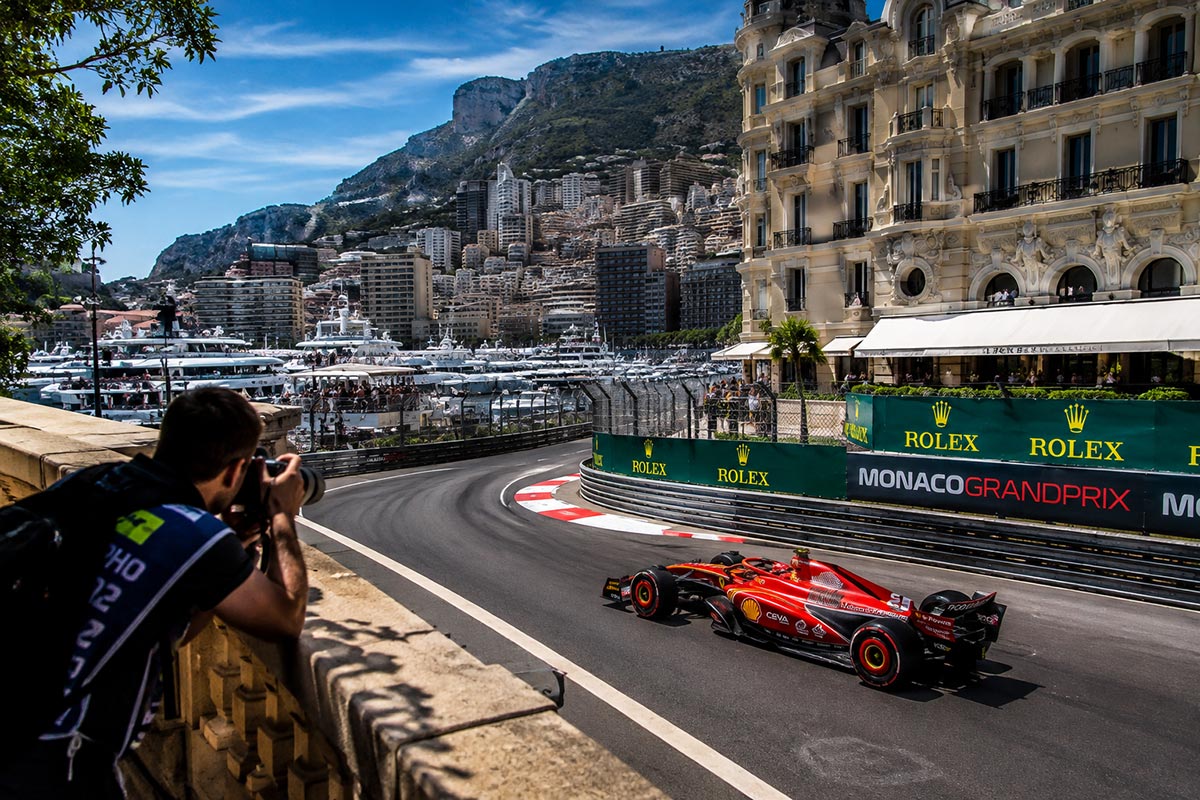
Best Places to Photograph Formula One Cars at the Monaco Grand Prix
Few Formula 1 races offer photographers a backdrop quite like Monaco. At most circuits, photographs are dominated by grandstands, run-off areas and advertising boards. At the Monaco Grand Prix, Formula 1 cars race past luxury hotels, apartment buildings, superyachts, palm trees and the sparkling Mediterranean.
The 3.337km Circuit de Monaco contains 19 turns and takes drivers through some of the most recognisable locations in motorsport.
For spectators interested in photography, this creates extraordinary opportunities. A photograph taken at Monaco can immediately communicate where it was captured, even without a caption.
Access is important, however. Monaco’s narrow streets, fencing and restricted areas mean you cannot simply move around the circuit taking photographs from wherever you choose while racing is underway. Your ticket, hospitality location or accommodation will largely determine the views available to you.
Here are some of the best areas to consider when planning a Monaco Grand Prix experience with photography in mind.
1. Casino Square – The Classic Monaco Photograph
If there is one location that captures the glamour of Monaco, it is Casino Square.
Formula 1 cars climb the hill from Sainte Dévote and Beau Rivage before reaching Massenet and sweeping through Casino Square. The surrounding architecture provides a background unlike anything found at a conventional race circuit.
The Hôtel de Paris Monte-Carlo, Casino de Monte-Carlo, landscaped surroundings and historic buildings can turn a photograph of a Formula 1 car into an unmistakably Monegasque image.
Formula 1 itself recommends Grandstand B at Casino Square for spectators looking for a particularly spectacular view.
For photography, the appeal is the combination of racing and location.
Rather than attempting to fill the entire frame with the car, consider photographing slightly wider. Including Monaco’s architecture provides context and creates an image that tells a story.
A fast shutter speed can freeze the car, while experimenting with slower shutter speeds and panning can introduce movement into the background.
2. The Fairmont Hairpin – Capture F1 Cars at Their Slowest
The Fairmont Hairpin is perhaps the easiest Monaco corner for casual spectators to understand photographically.
Formula 1 cars have to negotiate an extraordinarily tight turn using substantial steering lock. It is one of the most instantly recognisable sights of the Grand Prix.
Because the cars are travelling comparatively slowly, the hairpin can also be more forgiving for photographers than the high-speed sections.
At somewhere such as the Swimming Pool, a car can appear and disappear incredibly quickly. At the hairpin, there is more time to compose the shot and follow the car.
The distinctive angle of the cars also creates photographs that simply aren’t possible at most Formula 1 circuits.
Try capturing several cars together during the opening laps or after a Safety Car period. A line of brightly coloured Formula 1 cars wrapped around the famous hairpin makes an exceptional Monaco image.
3. Sainte Dévote – Speed, Braking and First-Lap Drama
Sainte Dévote is the first corner and one of Monaco’s classic action locations.
The distance from pole position to Turn 1 is less than 150 metres, making the opening moments particularly intense.
For photographers, Sainte Dévote offers several possibilities.
During practice and qualifying, individual cars provide opportunities to capture drivers attacking the corner. During the race, however, the opening lap can produce an entirely different photograph as the field arrives together.
A wider composition showing several cars entering the corner can often communicate the drama better than a tight shot of one car.
The uphill section beyond Sainte Dévote also gives a sense of Monaco’s dramatic elevation changes as the cars begin climbing towards Beau Rivage.
4. Beau Rivage – Photograph the Climb Through Monte Carlo
The climb from Sainte Dévote towards Massenet and Casino Square is another excellent location visually.
This part of the circuit demonstrates something photographs from television don’t always communicate effectively: Monaco isn’t flat.
Cars accelerate sharply uphill between Armco barriers and buildings.
The narrow ribbon of road can make an F1 car appear incredibly large and aggressive, particularly when photographed with a longer lens.
It is also an excellent location for images that emphasise the character of a street circuit. Include the barriers, buildings and elevation rather than attempting to remove them from the photograph.
They are part of what makes Monaco special.
5. Mirabeau – Close-Up Street Circuit Photography
After Casino Square, drivers begin descending towards Mirabeau and the Fairmont Hairpin.
Mirabeau provides classic street-circuit scenery, with cars appearing remarkably close to the barriers and surrounding buildings.
The change in elevation can create interesting photographic angles, while the slower cornering speed gives photographers more opportunity to track the cars.
This is a good place to concentrate on details: front wings, tyres, helmets and the proximity between the car and Armco.
At Monaco, sometimes the most effective image isn’t a sweeping Mediterranean panorama. A photograph showing a driver’s front tyre only centimetres from the barrier can communicate the precision required to race here.
6. Portier – Cars Heading Towards the Famous Tunnel
Portier is another particularly photogenic part of Monaco.
Cars negotiate the right-hander before accelerating into the tunnel. Formula 1 notes that Portier offers excellent harbour views and provides the drivers’ final sunlight before entering the tunnel.
That combination creates potential for photographs incorporating the harbour, surrounding buildings and Mediterranean light.
If your viewing location provides the appropriate angle, this is where a wider composition can work beautifully.
Instead of simply photographing a Formula 1 car, you’re photographing an F1 car racing through Monaco.
That distinction is important.
7. The Tunnel Exit and Nouvelle Chicane
Few moments demonstrate the speed of modern Formula 1 machinery like watching a car emerge from Monaco’s tunnel.
Drivers accelerate through the darkness before suddenly returning to daylight and braking heavily for the Nouvelle Chicane.
This is a technically challenging area for photographers because the cars are travelling extremely quickly. Autofocus settings, shutter speed and positioning become much more important.
But when everything works, the results can be spectacular.
The contrast between the dark tunnel and bright Monaco sunshine can also produce dramatic images, although exposure requires more care.
This area is ideal for photographers wanting photographs that communicate outright speed.
8. The Monaco Harbour – Cars and Superyachts in One Photograph
For an image that immediately says “Monaco Grand Prix”, try to incorporate Port Hercule.
During Grand Prix weekend, the harbour becomes filled with spectacular yachts, many of which provide hospitality and race viewing.
Finding an elevated viewing position that allows both Formula 1 action and the harbour to appear in the same composition can produce some of the weekend’s most memorable images.
This is one area where private balcony and terrace hospitality can have a major advantage over conventional grandstand seating.
Elevated balconies can provide much wider perspectives over Monaco, potentially incorporating the circuit, yachts, mountains, architecture and Mediterranean.
Grand Prix Adventures offers Monaco Grand Prix hospitality from private terraces and luxury yachts, giving guests a very different visual perspective from traditional grandstands.
For anyone who values photography as part of their Monaco experience, the viewing position should therefore be considered when selecting a package.
9. The Swimming Pool – One of Monaco’s Best Action Shots
If your priority is photographing Formula 1 cars looking fast, the Swimming Pool section deserves serious consideration.
Formula 1 specifically recommends Grandstands L to P around this section, where cars attack the chicane at high speed.
The rapid changes of direction create dramatic photographs.
Cars attack the kerbs, suspension loads up and drivers run extremely close to the barriers.
This is a great area for panning shots.
Rather than using an extremely fast shutter speed to completely freeze the car, a slower shutter combined with smoothly following the car can keep the subject relatively sharp while blurring the background.
It takes practice, but a successful panning photograph can communicate speed far more effectively than a completely frozen image.
10. La Rascasse – Atmosphere and Close-Quarter Racing
La Rascasse is another corner where Monaco’s street-circuit character is impossible to miss.
The cars negotiate the tight section surrounded by barriers, buildings and hospitality areas before beginning the final part of the lap.
Because speeds are lower than at the Swimming Pool or tunnel exit, photographers have more opportunity to follow the car.
The corner is also excellent for capturing the atmosphere surrounding the event.
Crowds, balconies, marshals and Monaco architecture can all become part of the composition.
11. Anthony Noghès and the Start-Finish Straight
The final corner, Anthony Noghès, leads drivers back towards the start-finish line.
Photographically, this area offers several different possibilities depending upon your position.
During the race you can capture cars accelerating towards the line, while the start itself provides one of the few opportunities to photograph the entire field closely grouped together.
After the chequered flag, this area can also become the focus of celebrations.
For photographers interested in telling the story of the whole weekend rather than simply collecting individual car photographs, race starts, pit activity, celebrations and crowd reactions can be just as valuable as on-track action.
Private Balconies and Terraces – A Photographer’s Advantage
Some of the most impressive Monaco Grand Prix photographs are taken from above the circuit.
Private terraces and apartment balconies provide an entirely different perspective from ground level.
From an elevated position, photographers may be able to show the circuit winding between Monaco’s buildings, capture several cars within the same frame or incorporate Port Hercule and its yachts.
There’s another practical advantage: you can often photograph from a comfortable position rather than spending an entire day holding heavy equipment in a grandstand.
Grand Prix Adventures offers a range of premium Monaco balcony and terrace hospitality experiences, including locations overlooking key sections of the circuit.
For keen photographers, discussing the view before selecting a hospitality package is worthwhile.
Yacht Hospitality – A Completely Different Perspective
Watching the Monaco Grand Prix from a yacht is one of Formula 1’s most distinctive experiences.
From Port Hercule, photography becomes as much about atmosphere as close-up motorsport action.
Superyachts, Formula 1 cars, surrounding apartment buildings, mountains and packed hospitality areas combine to create photographs that could only have been taken in Monaco.
A smartphone or moderate zoom lens may actually be more useful here than carrying large professional equipment.
The objective is often to capture the wider experience rather than filling the frame with a single car.
Photography Tips for the Monaco Grand Prix
A few basic techniques can significantly improve your photographs.
For close-up action, use continuous autofocus and burst shooting. Formula 1 cars move too quickly to rely on repeatedly acquiring focus for individual photographs.
For panning, start with a manageable shutter speed and gradually experiment with slower settings.
Don’t spend the whole weekend using maximum zoom. Monaco is one of the few races where the background can be as interesting as the car.
Photograph the harbour.
Photograph Casino Square.
Capture fans arriving in the morning, yachts filling Port Hercule, team activity, the circuit at dusk and Monaco after the roads reopen.
Formula 1 highlights walking the circuit after the day’s track action as one of the distinctive experiences of attending Monaco. That can also provide excellent opportunities to photograph the corners and surroundings without racing cars obscuring the architecture.
Check Camera Rules Before Travelling
Spectators should always check the current event regulations before bringing photographic equipment.
Official Monaco event information lists bulky equipment such as camera tripods among items prohibited from grandstands, and event terms place restrictions on commercial use of photographs and recordings made at the circuit.
Rules can change between events, so check the latest conditions applicable to your particular ticket before travelling, especially if you’re considering larger lenses or other specialist equipment.
For most visitors, a modern smartphone or compact mirrorless/DSLR setup will provide more than enough opportunity to return home with memorable images.
What Is the Best Place to Photograph the Monaco Grand Prix?
There isn’t one perfect location because it depends on the photograph you want.
For iconic Monaco architecture, choose Casino Square.
For slower cars and distinctive compositions, the Fairmont Hairpin is difficult to beat.
For outright speed, consider the Swimming Pool or tunnel exit.
For Monaco atmosphere, the harbour and yacht areas provide something no other Formula 1 race can truly replicate.
And for sweeping views combining cars, circuit and city, an elevated private balcony or terrace can offer the most complete photographic experience.
Ultimately, the best Monaco Grand Prix photographs don’t simply show a Formula 1 car.
They show a Formula 1 car in Monaco.
That might mean a Ferrari framed against Casino Square, a McLaren threading around the Fairmont Hairpin, cars flashing past superyachts in Port Hercule or the entire field disappearing between Monaco’s buildings.
These are the images that capture why the Monaco Grand Prix remains one of motorsport’s most extraordinary events.
For visitors who want to experience it first-hand, Grand Prix Adventures offers Monaco Grand Prix packages combining accommodation, transfers and premium race viewing, including luxury yacht hospitality and private balcony and terrace locations.
Choosing the right viewing position can give you much more than a great view of the race – it can give you a completely different way of seeing, experiencing and photographing Monaco.
FAQ
Where is the best place to photograph F1 cars at Monaco?
Casino Square is excellent for iconic Monaco backgrounds, while the Fairmont Hairpin is particularly good for photographing cars at slower speeds. The Swimming Pool section is better for dramatic high-speed action.
Is the Fairmont Hairpin good for Formula 1 photography?
Yes. The low speed and extreme steering angle make the Fairmont Hairpin one of Monaco’s most distinctive photographic locations.
Where can I photograph F1 cars with Monaco’s harbour in the background?
Elevated terraces and balconies around Port Hercule can provide views incorporating both the circuit and harbour. Yacht hospitality can also provide distinctive harbour-level perspectives.
What is the best Monaco Grand Prix grandstand for photography?
It depends on the desired image. Formula 1 recommends Grandstands L to P around the Swimming Pool for high-speed viewing and Grandstand B for a spectacular view of Casino Square.
Can I take a professional camera to the Monaco Grand Prix?
Always check the latest official ticket conditions before travelling. Equipment and usage restrictions apply, particularly regarding bulky equipment and commercial use of photographs. Official information specifically identifies camera tripods as prohibited bulky items in grandstands.
Experience Formula 1 with Grand Prix Adventures
Grand Prix Adventures offers expertly organised Formula 1 travel packages to some of the world’s most exciting races.
Packages can include carefully selected hotels, race tickets, transfers and dedicated support, allowing guests to concentrate on enjoying the atmosphere and action of a Grand Prix weekend.
Explore the latest Formula 1 packages and start planning an unforgettable motorsport experience.