
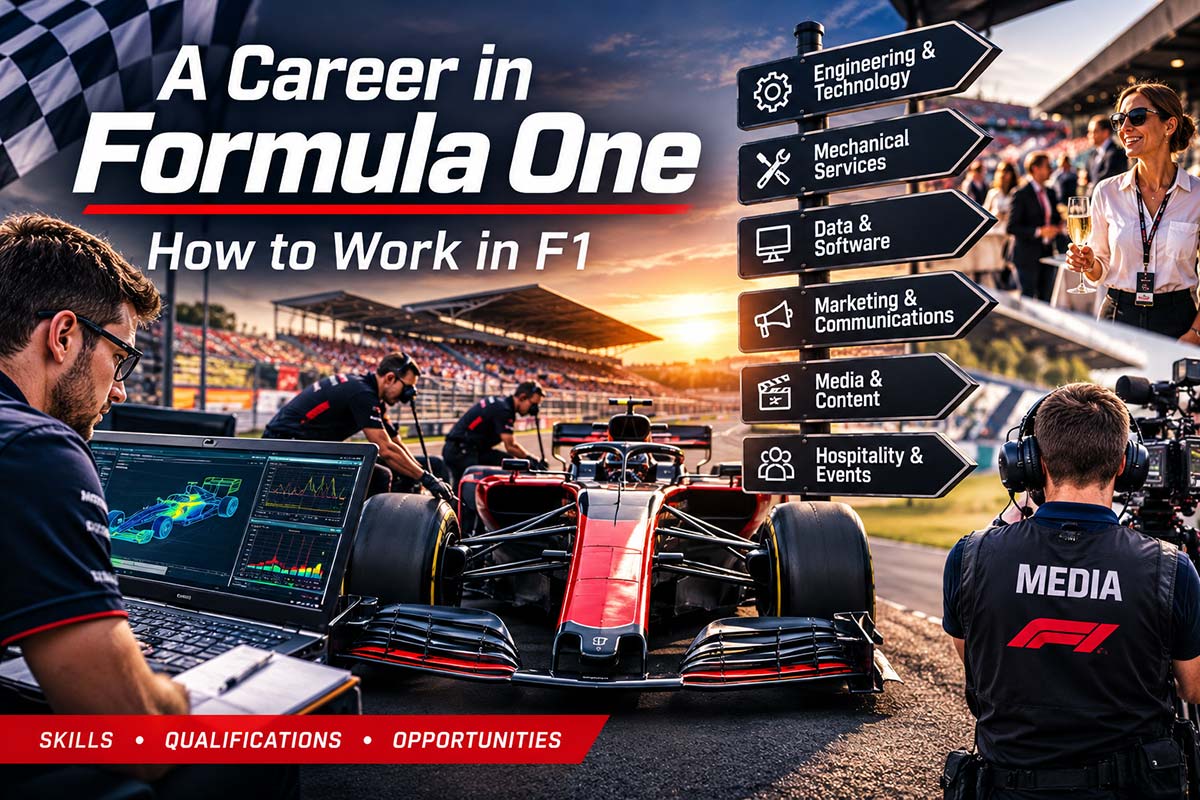
A Career in Formula One: How to Work in the World of F1
For millions of motorsport fans, a career in Formula One represents the ultimate opportunity to turn a passion for racing into a profession. Formula 1 may be famous for its drivers, spectacular cars and glamorous Grand Prix destinations, but behind every race weekend are thousands of people working across engineering, technology, logistics, marketing, hospitality, media and countless other disciplines.
Only 20 drivers can occupy the Formula 1 grid at any one time, but becoming a racing driver is far from the only route to a career in Formula One.
Modern F1 teams are sophisticated international organisations employing specialists from a huge variety of backgrounds. From aerodynamicists developing the next generation of racing cars to chefs preparing meals for travelling personnel, Formula 1 requires an enormous range of skills.
So, what types of jobs are available and how can you begin a career in Formula One?
Formula One Is Much More Than Racing Drivers
When most people think about working in F1, they immediately picture drivers, race engineers and mechanics standing in the pit lane.
These are certainly some of the most visible positions, but they represent only a fraction of the people required to operate a Formula 1 team.
Behind the scenes, hundreds of employees can work at a team’s headquarters designing, manufacturing, testing and developing its cars. Another group travels around the world as part of the race team.
There are also careers within Formula 1 itself, individual circuits, sponsors, broadcasters, hospitality companies, suppliers and the many businesses supporting the championship.
Potential Formula 1 careers include:
- Mechanical engineering
- Aerodynamics
- Electronics and electrical engineering
- Software development
- Data analysis
- Vehicle dynamics
- Composite manufacturing
- CNC machining
- Race mechanics
- Race engineering
- Strategy
- Logistics
- Marketing
- Public relations
- Social media
- Graphic design
- Photography and video production
- Broadcasting
- Journalism
- Finance and administration
- Human resources
- Catering
- Events and hospitality
- Travel management
- Sponsorship and commercial partnerships
It means someone who loves Formula 1 but has no desire to become a driver can still find numerous routes into the sport.
Engineering Careers in Formula One
Engineering is at the heart of Formula 1.
Every fraction of a second matters, meaning teams continually analyse how they can make their cars faster, more efficient and more reliable.
Mechanical engineers can work on areas including suspension, braking systems, transmissions and other components. Aerodynamicists concentrate on managing airflow around the car to produce performance while working within the technical regulations.
Other specialists work with electronics, simulation, control systems, power units, materials and vehicle dynamics.
The precise nature of modern Formula 1 means that engineering positions generally require strong academic qualifications. Degrees in subjects such as mechanical engineering, automotive engineering, aerospace engineering, electronics or related disciplines can provide an excellent foundation.
However, qualifications are only part of the equation.
Practical motorsport experience can be extremely valuable. University competitions such as Formula Student allow aspiring engineers to participate in the design and construction of racing cars while developing teamwork and problem-solving abilities.
Becoming an F1 Mechanic
For people who prefer practical hands-on work, becoming a Formula 1 mechanic can be an exciting career path.
Race mechanics are responsible for preparing and maintaining some of the most technologically advanced racing cars ever created.
The job involves considerably more than performing spectacular pit stops on television.
Mechanics help assemble cars, inspect components, make setup changes and ensure everything is operating correctly before the driver leaves the garage.
The pressure can be enormous. A small mistake could potentially affect an entire Grand Prix weekend.
Many mechanics begin through technical qualifications, apprenticeships or experience in lower categories of motorsport. Working with Formula Ford, Formula 4, GT racing or other championships can provide invaluable practical experience.
Progressing through motorsport can eventually open opportunities with larger teams and ultimately Formula 1.
Data, Software and Technology Careers in F1
Modern Formula 1 cars generate enormous amounts of information.
Teams analyse data relating to tyres, temperatures, aerodynamic performance, fuel, brakes, suspension, engine performance and countless other variables.
As a result, careers involving data science, software engineering and computing have become increasingly important.
Some employees work at the circuit while others remain at the team’s factory, supporting race operations remotely.
Simulation is another crucial area.
Drivers spend significant amounts of time using sophisticated simulators to help teams understand car setup and prepare for upcoming circuits. Engineers can use simulation tools to assess potential changes before expensive components are manufactured.
Someone studying computer science, mathematics, artificial intelligence or data analytics may therefore possess skills that are highly relevant to Formula 1 despite never having studied traditional automotive engineering.
Marketing and Commercial Careers in Formula One
A career in Formula One doesn’t necessarily require a technical background.
F1 teams are major global brands with millions of supporters and partnerships involving some of the world’s biggest companies.
That creates opportunities within marketing, sponsorship, communications and commercial operations.
Marketing teams develop campaigns that connect teams with fans around the world. Social media specialists create content across multiple platforms, while public relations professionals manage communication with journalists and broadcasters.
Commercial teams work with sponsors and corporate partners whose financial support plays an important role in Formula 1.
Graphic designers, photographers, videographers and content creators are also essential as teams compete for attention away from the racetrack as well as on it.
For people with qualifications or experience in marketing, communications, business or creative industries, these roles provide another potential route into Formula 1.
F1 Hospitality and Events
Hospitality is a huge part of the modern Grand Prix experience.
Formula 1 attracts corporate guests, sponsors, celebrities and motorsport enthusiasts from across the world, particularly at prestigious events such as Monaco, Silverstone, Abu Dhabi and Las Vegas.
That creates careers involving event management, guest services, catering, travel, accommodation and VIP hospitality.
Working in this area can provide an entirely different perspective on Formula 1.
Rather than developing the racing car, hospitality professionals concentrate on creating an exceptional experience for the people attending the event.
Grand Prix Adventures has been organising Formula One travel and hospitality experiences since 2004, demonstrating just how extensive the industry surrounding the racing itself has become.
Working in Formula 1 Media
The global popularity of Formula 1 has created an enormous media industry.
Television broadcasters require presenters, commentators, producers, camera operators, sound technicians and editors.
Motorsport websites and publications employ journalists, photographers and digital content specialists.
Formula 1 teams themselves now operate sophisticated media departments producing everything from technical features and interviews to behind-the-scenes videos and social media content.
There are also opportunities within podcasting, digital production and online motorsport journalism.
Building experience is particularly important in this area. Aspiring journalists can begin covering club-level motorsport, while photographers and video producers can develop portfolios at smaller racing events before attempting to progress into international motorsport.
Do You Need a University Degree to Work in Formula One?
It depends entirely on the career.
Highly technical positions such as aerodynamicist or design engineer will usually require relevant academic qualifications.
Other positions may place greater importance on vocational qualifications, apprenticeships and practical experience.
A mechanic, for example, could progress through technical training and experience within motorsport rather than following a traditional university route.
Marketing, finance, communications and business roles may favour relevant degrees, but professional experience can be equally important.
The key is to identify the Formula 1 career that interests you and research the qualifications typically required for that specific position.
Start Your Career in Motorsport Before Formula One
One of the biggest mistakes aspiring F1 professionals can make is concentrating exclusively on Formula 1 jobs.
The motorsport industry is much larger than F1.
Hundreds of racing teams compete in championships throughout Britain, Europe and the rest of the world.
Working with a smaller team can provide experience that is difficult to obtain by simply applying directly to a Formula 1 organisation.
Club motorsport, karting, Formula 4, Formula 3, endurance racing, GT racing and other championships all require engineers, mechanics and support personnel.
Volunteering can also help younger people understand how motorsport works while making useful contacts.
The objective should be to build genuine experience rather than simply having Formula 1 written on your first job application.
Internships, Placements and Apprenticeships
Formula 1 teams recognise the importance of developing future talent.
Depending upon the organisation and role, opportunities can include apprenticeships, internships, industrial placements and graduate programmes.
Competition for these positions can be intense.
A strong application therefore needs to demonstrate more than an enthusiasm for watching Formula 1.
Teams want evidence of relevant ability.
Engineering applicants might highlight Formula Student participation, practical projects, CAD experience or previous motorsport involvement.
Someone pursuing marketing could demonstrate successful campaigns, content creation or event experience.
Applicants interested in software could create projects demonstrating programming and data-analysis skills.
The question isn’t simply, “How much do you love Formula 1?”
It is, “What can you contribute to a Formula 1 organisation?”
What Skills Do Formula 1 Teams Look For?
Technical ability is important, but working in Formula 1 also demands strong personal qualities.
Motorsport operates under relentless deadlines. A Grand Prix won’t be delayed because a team hasn’t finished preparing its car.
Employees therefore need to perform under pressure.
Teamwork is equally important.
A Formula 1 victory isn’t created by one driver or one engineer. Hundreds of people contribute to designing, building, developing and operating the car.
Problem-solving is another valuable skill. Unexpected situations constantly occur during race weekends, requiring teams to analyse information and make decisions quickly.
Flexibility is also important, particularly for travelling positions.
The Formula 1 calendar crosses continents and time zones, and race-team personnel can spend considerable periods away from home.
For some people this is one of the attractions of an F1 career. For others, the travel demands can make factory-based positions more appealing.
How Competitive Is a Career in Formula One?
Extremely competitive.
Formula 1 represents the highest level of international single-seater motorsport, so vacancies can attract applicants from around the world.
That shouldn’t discourage anyone from pursuing a career in Formula One, but expectations should be realistic.
Building relevant experience, developing specialist skills and establishing professional contacts can take years.
Persistence matters.
Someone who initially fails to secure a Formula 1 position might gain valuable experience elsewhere in motorsport and apply again several years later with a considerably stronger CV.
There isn’t one perfect route into F1.
Networking in Motorsport
Motorsport remains an industry where relationships can be valuable.
That doesn’t mean you need to know someone already working for an F1 team.
Networking can begin by attending motorsport events, joining university projects, volunteering, participating in professional organisations and communicating with people working in your chosen discipline.
LinkedIn can also be useful for understanding how people currently working in Formula 1 developed their careers.
Rather than immediately asking someone for a job, examine their career progression.
Where did they study?
What was their first motorsport position?
Which championships did they work in before reaching Formula 1?
You may discover that many careers are far less straightforward than expected.
Experiencing Formula One First-Hand
If Formula 1 is your passion, attending a Grand Prix can provide an entirely different understanding of the scale of the sport.
Television naturally concentrates on the cars and drivers, but at the circuit you begin to appreciate the enormous operation required to stage a Formula 1 weekend.
Teams, broadcasters, hospitality staff, logistics crews, officials, security personnel, media representatives and countless other professionals work together to create the event.
Grand Prix Adventures has been taking guests to Formula 1 events around the world for more than two decades, with race experiences ranging from premium circuit viewing and hospitality to hotels, transfers and exclusive Grand Prix experiences.
Seeing Formula 1 close up can be inspirational for anyone considering making motorsport their career.
Is a Career in Formula One Achievable?
A career in Formula One is difficult to achieve, but there are far more opportunities than many people realise.
You don’t necessarily need to design racing cars or be capable of changing four tyres in seconds.
Formula 1 needs engineers, programmers, accountants, marketers, designers, chefs, logistics specialists, journalists, event professionals and people from many other backgrounds.
Start by identifying where your existing interests and abilities could fit into the sport.
Then develop the qualifications and experience required for that particular area.
Most importantly, don’t wait for Formula 1 to provide your first opportunity.
Start building your career through education, projects, internships, lower levels of motorsport or relevant industries. Every piece of experience can move you closer to the ultimate goal.
For those who succeed, a career in Formula One offers the opportunity to work at the forefront of technology, competition and international sport – and to play a part in the extraordinary spectacle enjoyed by millions of F1 fans around the world.
Frequently Asked Questions About a Career in Formula One
How do I start a career in Formula One?
Choose the area of Formula 1 that matches your skills, obtain the appropriate qualifications and begin building relevant experience. Motorsport placements, apprenticeships, Formula Student and jobs with teams in lower racing categories can all provide routes towards F1.
What qualifications do you need to work in Formula 1?
Qualifications depend on the role. Engineering positions often require relevant degrees, while mechanics may enter through apprenticeships and vocational training. Careers in marketing, finance, media and hospitality have their own qualification and experience requirements.
Can you work in Formula 1 without an engineering degree?
Yes. Formula 1 organisations require people working in marketing, communications, finance, IT, logistics, HR, hospitality, media and many other non-engineering disciplines.
Is it difficult to get a job in Formula 1?
Formula 1 jobs are highly competitive because teams attract applicants internationally. Relevant qualifications, practical experience, specialist skills and persistence can considerably strengthen an application.
Do Formula 1 employees travel to every race?
No. Only part of a Formula 1 team’s workforce travels to Grands Prix. Many employees work primarily at team headquarters in engineering, manufacturing, simulation, design and support positions.
What is the best degree for a career in Formula One?
There isn’t one best degree because Formula 1 employs people across numerous disciplines. Mechanical, automotive, aerospace, electronic and software engineering degrees are relevant to technical careers, while other departments recruit graduates in areas including business, marketing, finance and communications.
Experience Formula 1 with Grand Prix Adventures
Grand Prix Adventures offers expertly organised Formula 1 travel packages to some of the world’s most exciting races.
Packages can include carefully selected hotels, race tickets, transfers and dedicated support, allowing guests to concentrate on enjoying the atmosphere and action of a Grand Prix weekend.
Explore the latest Formula 1 packages and start planning an unforgettable motorsport experience.